
Lens Replacement Surgery
From Only
£59/mo

4.8 / 5 Rated excellent on Trustpilot

14 Top Rated Private Hospitals across the country

Daily appointments available from the convenience of your own home.
Private Treatments Only.
NHS queries 0207 509 4186



No-obligation video or telephone call with our expert team to establish treatment suitability.
Advanced and comprehensive diagnostic tests to determine your ideal treatment.

Tailored cataract plan designed just for you.
Lens replacement surgery, also known as Refractive Lens Exchange (RLE), is an advanced vision correction procedure that replaces your eye’s natural lens with a clear, artificial intraocular lens (IOL). This modern treatment is designed to improve your vision and can significantly reduce, or even remove, your need for glasses or contact lenses.
The surgical technique used for RLE is the same as that used in modern cataract surgery. However, the purpose of each procedure is different. Cataract surgery is carried out when the natural lens has become cloudy and is affecting vision. RLE, on the other hand, is an elective treatment for patients whose lenses are still clear, but who want a long-term solution to age-related vision changes or a greater level of independence from glasses.
At Optegra, your consultant will carefully assess your eyes and discuss whether lens replacement surgery is the right option for your lifestyle and visual goals.
Well you are a bit trepidatious with someone touching your eyes, but the team reassured me so much, and it was very quick – only around 20 minutes for both eyes – and completely painless. It could not have been easier to be honest, it was completely fine. […] Now I can look forward to life being easier. No glasses frame blocking my peripheral vision when driving, no forgetting my specs when I leave the house and everything being a blur, no glasses falling off when I play with my kids – this is liberating!
Your suitability for lens replacement surgery will be carefully assessed during a detailed consultation. Your consultant will consider your age, overall eye health and personal vision goals before recommending the most appropriate treatment.
Lens replacement surgery is often a good option for patients who may not be suitable for laser eye surgery, such as those with higher prescriptions or thinner corneas. It is designed to treat a range of common vision concerns, including:
As the natural lens is replaced during the procedure, patients who undergo lens replacement surgery will not go on to develop cataracts in the future. This removes the need for cataract surgery later in life.
Your consultant will talk through all of these factors with you to ensure lens replacement surgery is the right choice for your eyes and your lifestyle.
I was apprehensive of the idea of Lens replacement surgery. However from my first consultation all the staff at Optegra put me at ease with their positive reassuring advice and answers to my concerns. On the day of surgery, I was actually looking forward to it. Dr Amir Hamid was excellent, from greeting me and answering my questions, to carrying out the pain free surgery. I have never had a surgical experience that was so pain free. He explained the procedure throughout the surgery, providing constant reassurance. Post surgery after three days, I could read the small print on my phone, whilst far vision was clear day after surgery. Having had my post op assessment a week later. My vision is better than 20/20. Amazing. It was great to see Dr Hamid again and personally thank him not only for a great surgical experience, but giving me the glasses free eye sight after 45years of reliance on glasses and contact lenses. The second phase of my life has begun, all thanks to the staff at Optegra and especially Dr Hamid 🙏🏽
Refractive lens exchange is performed as a day-case procedure, so you can return home shortly after your treatment. Many Optegra patients choose to have both eyes treated on the same day, allowing for a quicker overall recovery and faster visual improvement. In some cases, your consultant may recommend treating each eye separately, depending on your individual needs.
On the day of surgery, anaesthetic eye drops are used to ensure the procedure is comfortable. If required a mild sedative can also be offered to help you feel relaxed. Your consultant will make a very small incision in the surface of the eye to access the natural lens. The lens is gently emulsified using advanced ultrasound technology and carefully removed before being replaced with a clear artificial intraocular lens.
Optegra offers a range of advanced lens options, including multifocal intraocular lens designs that are intended to improve vision at near, intermediate and distance ranges. Your consultant will guide you through the most suitable option to help you achieve clearer vision and greater independence from glasses or contact lenses.

Anaesthetic eye drops applied to ensure a pain-free procedure

Small incision made at the base of the cornea for surgical access
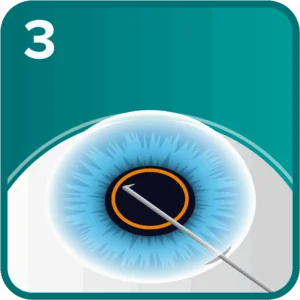
The front of the lens capsule is removed

The natural lens is ultrasonically broken up and removed

The IOL is inserted and positioned within the lens capsule

I honestly had no reservations about having it done. The private suite in Manchester is so relaxing and comfortable, and the team put me at ease and were so welcoming and informative. You may feel slightly nervous on the day which is natural, but it is the most painless procedure, it is a fast process, you feel nothing and it is life changing!
| Lens Type | What will my vision be like? | Convenient for… | Will I still need glasses? |
|---|---|---|---|
| Monofocal | Corrects vision at one fixed distance (usually far vision) | Convenient for prioritising driving, watching TV, scenic views | Yes. You will likely still need reading glasses for your phone, books, or computer |
| Multifocal & Trifocal | Corrects vision at multiple distances | Convenient for an active Lifestyle | Rarely (5% of cases). These lenses aim to provide a full range of vision, significantly reducing your need for glasses |
| Toric | Corrects vision distorted by an uneven eye shape (astigmatism) | Convenient for individuals with astigmatism | Depends. Toric versions can be added to both monofocal or multifocal lenses to ensure the sharpest possible result |
Recovery from lens replacement surgery is usually quick, with many patients noticing clearer vision within 24 to 48 hours. It is normal to experience some temporary blurring, light sensitivity or mild discomfort in the first few days as the eye begins to heal. You will be given eye drops to support recovery and reduce the risk of infection.
Most people feel ready to return to work after around three days, depending on their role, your consultant will advise you when returning to work is appropriate for you. You can resume driving after surgery once your consultant confirms that your vision meets the legal standard at your follow-up appointment.
To support smooth healing, it is important to avoid rubbing your eyes, swimming, dusty environments, or strenuous exercise in the early weeks. Optegra provides comprehensive aftercare for up to one year, including follow-up appointments and access to a 24-hour helpline, so you feel fully supported throughout your patient journey.
We believe in transparent pricing, with no hidden costs. During your free initial consultation, your consultant will assess your eyes and recommend the most suitable treatment. You will then receive a clear, personalised quote based on your individual needs.
In some cases, pricing for more complex prescriptions may vary. As lens replacement surgery is an elective vision correction procedure, it is not funded by the NHS.
Try changing your payment period.
* Interest bearing, based on 9.9% PA
Yes. Lens replacement, also known as Refractive Lens Exchange, is a well-established and highly effective procedure with an excellent safety record. At Optegra, treatment is carried out by NHS-trained Consultant Ophthalmic Surgeons in specialist eye hospitals, using advanced diagnostic and surgical technology.
As with any surgical procedure, there are potential risks, but serious complications are uncommon and are usually manageable if they arise. At Optegra, 99.1% of procedures are completed with no operative complications, reflecting our commitment to safety, expertise and high clinical standards.
“Refractive eye surgery” is a broad term used to describe procedures that correct vision. While both treatments aim to improve your sight, they work on different parts of the eye.
Your consultant will explain which option is most suitable for you, based on your eye health, prescription and long-term visual needs.
Yes, but it may restrict the range of lenses available to you. Your Consultant Ophthalmic Surgeon will discuss all your options at a free consultation.
Yes. Lens replacement surgery, also known as Refractive Lens Exchange, uses the same surgical technique as modern cataract surgery. If you already have a cataract, or are in the early stages of developing one, the cloudy lens is removed and replaced with a clear artificial lens during the procedure.
An important benefit of lens replacement surgery is that once your natural lens has been replaced with a synthetic implant, you will not develop cataracts in the future. This means you will not require cataract surgery later in life.
Your consultant will explain how this applies to your individual eye health and long-term vision needs.

Not ready for a consultation? Learn more about our range of treatments, doctors and hospitals
Information pack
Book your virtual consultation with our top rated eye hospitals
Book Now
We'll answer any questions you may have about treatment.
Private: Mon-Thu: 8am – 6pm, Fri: 8am – 5.30pm NHS: Mon-Fri: 8am – 6pm

Manage your existing bookings & payments
Patient Portal
Dr Alastair Stuart is Medical Director at Optegra, and has extensive experience in both Laser eye surgery and Cataract Surgery.
Medically Reviewed Date: 2nd September 2026