


Mr Amir Hamid has spent his career at the forefront of ophthalmic care, completing over 10,000 cataract and laser refractive surgeries. However, last year, the Chief Medical Officer for Optegra found himself in an unfamiliar position: sitting in the patient’s chair.
His story is a powerful reminder that eye health can change in an instant, and that swift action is the key to preserving one of our most precious senses.
The Warning Signs: A Detached Retina
Mr Hamid noticed a sudden, alarming change in his sight that made him unexpectedly become the patient. “At the end of July, I noticed that there was a blank patch in the field of vision in my right eye and immediately realised that it could be the start of a detached retina”, he recalled.
A detached retina occurs when the thin layer at the back of the eye becomes loose. For those with high myopia (short-sightedness), the risk is higher. As Mr Hamid explains:
“I am very short-sighted, and a detached retina can be common in myopic eyes. We tend to have very big eyes, and the retina at the back of the eye is thinner at certain points. This means the vitreous solution (the fluid inside the eye) can detach more easily and pull on the retina. It can pull on the weak part of the retina, which may then tear and detach.”
Within just three hours, Mr Hamid was scheduled for emergency surgery. Thanks to his quick reaction, the tear was treated before it could affect his central vision, allowing him to return to work within weeks.
From Recovery to a New Challenge: The Onset of Cataracts
Recovery from retinal surgery often brings a secondary challenge: the development of a cataract. While this usually takes years, for Mr Hamid, it arrived in months. By November, he noticed a “myopic shift”. His distance vision was fading, while his near vision was becoming strangely sharp.
For a surgeon who operates in a tiny “two millimetres by 10 millimetres space,” perfect vision isn’t just a preference, it’s a professional necessity. “I couldn’t wait for my vision to be impaired before I did something about it,” he said.
The Transformation: Lens Replacement Surgery
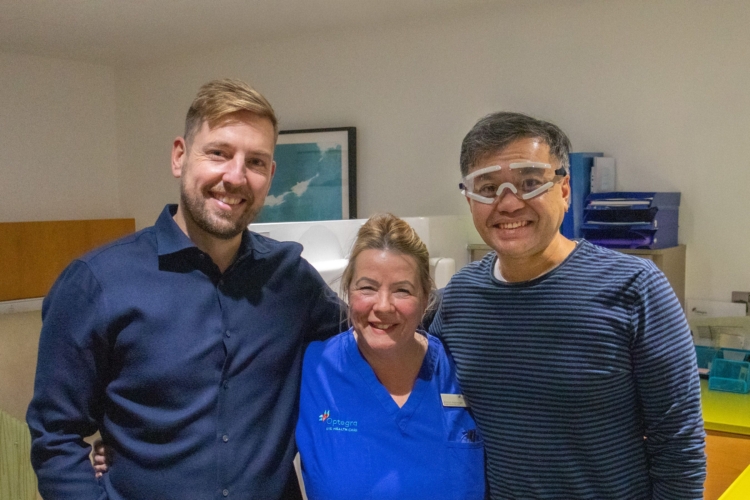
Mr Hamid underwent cataract surgery at the Optegra Hospital in Hampshire, performed by his colleague and Optegra Medical Director, Mr Alastair Stuart. They decided to treat the cataract in the right eye and perform lens replacement surgery on the left eye simultaneously, aiming to eliminate his need for glasses.
Despite his expertise, the experience of being “on the other side” was eye-opening: “I was not nervous going into it, but the heart rate monitor, which was attached to my fingers, was going off very quickly during the procedure. But I was told that I was a good patient, and it went very smoothly, and it was completely pain-free.”
Seeing is Believing
After 40 years of wearing glasses, the results were instantaneous. “I was immediately like wow, this is crazy,” Mr Hamid shared. “The next day, my eyesight got even better in terms of my distance vision. I couldn’t believe how crisp, how sharp and how colourful things were.”
For Mr Hamid, this wasn’t just a medical success; it was a “full-circle moment” that validated every conversation he has with his own patients: “I tell my patients all the time that they will have great results, but when it happens to you, it really validates the things that you’ve been saying. Seeing is believing. I couldn’t really describe the joy that I felt.”
Life Beyond the Operating Theatre
The benefits of the surgery have spilled over into Mr Hamid’s personal life, from playing with his children without the fear of breaking his glasses to his passion for culinary arts. As an avid cook who shares his dishes with a high-level online group, he notes: “I really enjoy plating my food so that it looks its absolute best, and the standard on the online group is pretty high. In fact, two guys in the group have gone on MasterChef. It’s so much fun, and so precise, and having brilliant vision is vital.”
A Message to You: Don’t Ignore the Symptoms
Mr Hamid is now using his experience to further encourage others to prioritise their eye health. Whether it is a cataract or a more urgent issue such as a retinal tear, early diagnosis is essential.
- Symptoms you should never ignore:
- Flashing lights or a sudden increase in floaters.
- A “black curtain” moving across your field of vision.
- Blurred vision at different distances.
“You certainly shouldn’t ignore the symptoms of retinal detachment, because it can lead to loss of vision,” Mr Hamid warns. “Remember that it’s always better to have a diagnosis, because then we know what it is and how we can fix it.”
“The older population in particular, are often more accepting of certain changes or compromises in their lifestyle and health, but that shouldn’t be the case because things can be done.” Mr Hamid expresses.
Ready to See the World with a New Perspective?
If you’re experiencing changes in your vision or simply want to explore how vision correction could change your life, don’t wait for your symptoms to advance.
As Mr Amir Hamid’s journey proves, early diagnosis is the key to preserving your sight – and the results can be truly life-changing. Whether you’re noticing the first signs of a cataract or are ready to live a life free from glasses, our team of experts is here to guide you every step of the way. Book a free consultation today!

By Author: Alastair Stuart
Dr Alastair Stuart is Medical Director at Optegra, and has extensive experience in both Laser eye surgery and Cataract Surgery.
Medically Reviewed Date: 19th January 2026