
Private Cataract Surgery
Book Your FREE Video or Telephone Consultation
£51/mo

4.8 / 5 Rated excellent on Trustpilot

14 Top Rated Private Hospitals across the country




No-obligation video or telephone call with our expert team to establish treatment suitability.
Advanced and comprehensive diagnostic tests to determine your ideal treatment.

Tailored cataract plan designed just for you.
Cataract surgery is a common and effective procedure that can restore clearer vision when cataracts begin to get in the way of everyday life.
At Optegra, private cataract surgery is led by experienced consultant ophthalmic surgeons and tailored to your individual eye health, lifestyle and vision goals. You won’t need a GP referral to start your journey, and you’ll have access to a choice of lens options that can not only treat your cataracts, but may also reduce your reliance on glasses.
From your first assessment through to your surgery and aftercare, we’ll make sure you understand your options and know exactly what to expect.
Private cataract surgery at a glance:
Cataract surgery replaces the natural lens inside your eye when it has become cloudy with a cataract.
During the procedure, your consultant surgeon makes a tiny incision in the eye and gently removes the cloudy natural lens. It is replaced with a clear artificial lens called an intraocular lens, or IOL. The replacement lens stays permanently inside your eye and allows light to focus more clearly again.
Cataract surgery is usually performed under local anaesthetic, so you’ll be awake, but your eye will be numb and comfortable during the procedure. You’ll normally be able to return home on the same day.
The cataract itself cannot return once the cloudy natural lens has been removed.
A cataract develops when the normally clear lens inside your eye gradually becomes cloudy. Cataracts usually develop slowly and are particularly common as we get older, although they can occur earlier in life too.
As a cataract develops, you may notice:
Small changes to glasses or brighter lighting can sometimes help in the early stages, but surgery is the only treatment that permanently removes a cataract.
*Actual results may vary.
Having a cataract doesn’t automatically mean you need surgery straight away.
The right time to consider treatment is usually when changes to your vision start affecting the things that matter to you. That might be feeling less confident driving at night, struggling to read comfortably, finding screens harder to see, or simply noticing that your eyesight is stopping you from enjoying everyday life as you used to.
You may wish to consider cataract surgery if:
There isn’t one right moment for everyone. Your consultant will assess your eyes and explain what surgery could realistically achieve, so you can decide when treatment feels right for you. Learn more about when cataracts may need treatment.
Cataract surgery is suitable for most adults who have been diagnosed with cataracts, particularly when changes to their sight begin to affect everyday activities.
Cataracts are most common in people over 60, but there is no single age at which cataract surgery becomes appropriate. Cataracts can also develop earlier due to genetics, previous eye injury, certain medications or health conditions such as diabetes.
At Optegra, your suitability is assessed individually. We look at:
Although most people with cataracts can have surgery, there are circumstances where treatment may need to be delayed or may not provide the improvement in vision you are hoping for.
These can include:
Having another eye condition doesn’t necessarily mean you can’t have cataract surgery. It simply means your consultant will need to consider how much of your reduced vision is caused by the cataract and how much is related to the other condition.
If additional treatment is needed first, your consultant will explain why and talk you through the next steps.
Cataracts are often diagnosed by an optician after you’ve noticed changes such as blurred or cloudy vision, increased glare or a gradual decline in your sight.
However, you don’t need a GP referral to arrange private cataract treatment with Optegra. If you’ve been diagnosed with cataracts or think you might have cataracts, you can contact us directly to arrange your free virtual consultation and explore private treatment.
Your Optegra face-to-face assessment includes detailed diagnostic tests to understand your cataracts, measure your eyes and assess your overall eye health. Your consultant can then explain whether surgery is suitable and discuss the treatment and lens options that may be appropriate for you.

Private cataract treatment gives you more choice over when you’re treated and the type of vision you would like to achieve after surgery.
Depending on your individual suitability, private treatment with Optegra can offer:
For some people, the priority is simply restoring clearer distance vision. Others would like to reduce the number of situations in which they need glasses.
Neither choice is inherently better. The important thing is choosing a treatment that suits your eyes and your life.
If you’re weighing up your options, our guide to private cataract surgery vs NHS cataract surgery explains the key differences to help you make an informed decision.
If you’re looking for NHS-funded treatment instead, please visit our NHS cataract surgery page.
The surgical technique used to remove a cataract is broadly the same. The main difference between private cataract treatment options is the intraocular lens placed inside your eye afterwards and the type of vision it is designed to provide.
Optegra offers three main private cataract treatment options.
£2,995 per eye
Standard cataract surgery uses a high-quality monofocal intraocular lens.
A monofocal lens provides a clear focus at one chosen distance. Most people choose clearer distance vision, for activities such as driving or watching television, and continue to wear reading glasses for close-up tasks.
Alternatively, the lens can sometimes be targeted towards nearer vision, with glasses then required for distance.
Standard cataract treatment can be an excellent choice if your main priority is removing your cataract and restoring clearer vision without needing a more complex range of vision correction.
This is the only cataract treatment available on the NHS (GP or optician referral required). At Optegra, we offer drop-free aftercare as standard for eligible NHS patients.
£3,695 per eye
Enhanced cataract surgery provides additional vision correction for suitable patients.
For people with astigmatism, a toric intraocular lens can correct the astigmatism at the same time as the cataract is removed.
Other enhanced lens options can provide a broader range of clear vision than a standard monofocal lens, particularly at intermediate distances such as a computer screen.
You may still need glasses for some tasks, particularly close-up reading, but enhanced treatment can help reduce your dependence on them.
£4,195 per eye
Advanced cataract treatment uses premium lens technology designed to provide clearer vision across a wider range of distances.
Multifocal lenses can help suitable patients see at near, intermediate and far distances and can significantly reduce dependence on glasses for everyday activities such as reading, using digital devices and driving.
No lens can guarantee complete freedom from glasses, and advanced lenses aren’t suitable for everyone. Some people can experience visual effects such as glare or halos around lights, particularly while their vision adapts.
Your consultant will discuss these considerations carefully before recommending an advanced lens.

There’s no single ‘best’ cataract lens. The right option depends on your eyes, your lifestyle and what you want your vision to do after surgery.
Your consultant may discuss several types of intraocular lenses, including:
Designed to give clearer vision at one main distance, usually far. Glasses will usually still be needed for another distance, such as reading.
Designed for people with astigmatism. They correct astigmatism while replacing the cataractous lens.
Provide a slightly broader range of clear vision than traditional monofocal lenses, particularly for intermediate tasks such as computer use.
EDoF lenses are designed to extend the range of clear vision, typically providing strong distance and intermediate vision while reducing reliance on glasses for many everyday tasks.
Designed to provide vision across multiple distances, including near, intermediate and far, with the aim of significantly reducing dependence on glasses.
Not every lens is right for every eye. Conditions affecting the retina, optic nerve or surface of the eye can influence which option will provide the best balance of visual quality and independence from glasses. People who drive frequently at night may also have different priorities from someone whose main concern is reading or close-up work.
Your consultant will explain the benefits and limitations of each suitable option. We want you to know not just what a lens can do, but what you can realistically expect from it.
*Actual results may vary.
Cataract surgery is a quick, minimally invasive procedure carried out under local anaesthetic, so you’ll be awake, but your eye will be numbed and comfortable throughout.
Once the eye is numb, your consultant surgeon makes a tiny incision and uses a fine ultrasound probe to gently break up and remove the cloudy natural lens.
Your chosen intraocular lens is then inserted into the lens capsule and carefully positioned inside the eye. The new lens is designed to remain in place permanently.
The incision is extremely small and will usually heal naturally without stitches.
The surgery itself generally takes around 8–20 minutes per eye at Optegra. You’ll then rest in a recovery area and have the appropriate checks before going home the same day.
You’ll need someone to take you home because you won’t be able to drive immediately after surgery.
Read our guide on preparing for cataract surgery.
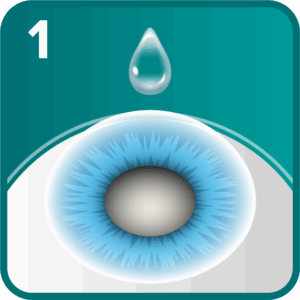
Anaesthetic eye drops applied to ensure a pain-free procedure
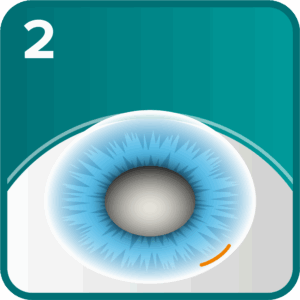
Small incision made at the base of the cornea for surgical access
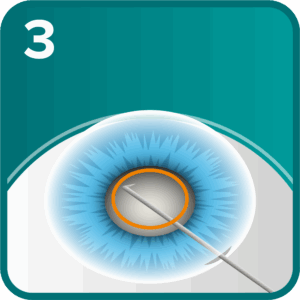
The front of the lens capsule is removed
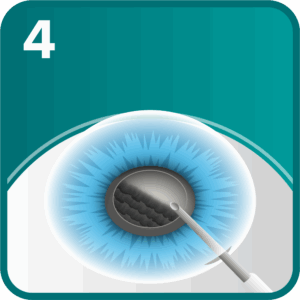
The clouded lens is ultrasonically broken up and removed
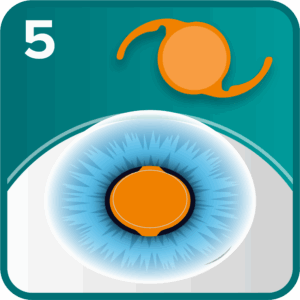
The IOL is inserted and positioned within the lens capsule
Optegra is a great place to come for cataract surgery because we combine therapeutic procedure with a refractive procedure to restore vision but also impart spectacular independence.Dr Amir HamidChief Medical Officer & Consultant Ophthalmic Surgeon
For most private patients, yes.
Where clinically appropriate, Optegra aims to treat both eyes during the same hospital visit. This is known as bilateral sequential cataract surgery, where both eyes are treated during the same visit, one immediately after the other.
Having both eyes treated on the same day can mean:
Same-day treatment isn’t right for everyone, so your consultant will first assess whether it is appropriate for your eyes and general health.
If your eyes need to be treated separately, your consultant will explain the recommended timing between procedures.
The main purpose of cataract surgery is simple: to remove the cloudy lens that is affecting your sight and restore clearer vision.
For suitable patients, the benefits may include:
The artificial lens itself does not develop another cataract, so once your cataract has been removed, that cataract cannot grow back.
Your exact visual result will depend on your eye health, your prescription and the type of lens chosen. Your consultant will discuss your expected outcome with you before treatment.
We believe the cost of treatment should be clear from the start.
Current Optegra private cataract surgery prices begin at:
Cataract surgery with a monofocal lens.
Cataract treatment with additional vision correction, including options for astigmatism.
Advanced lens technology designed to provide clearer vision across multiple distances.
For further information, please view our cataract surgery costs page.
Your consultation will help determine which options are clinically suitable for you before you make any decision.
Optegra also offers payment plans, including 0% APR finance over 12 or 24 months, subject to eligibility and applicable terms. Private medical insurance may cover some or all of the cost of cataract surgery depending on your provider and policy.
You can find out more about private medical insurance or speak to our team about your payment options.
Most people find recovery from cataract surgery relatively straightforward.
Your vision may initially seem blurry, bright or slightly unusual as your eye begins to heal and adapt to its new lens. Mild grittiness, watering, redness or sensitivity to light can also occur during the first few days.
Many people can return to light everyday activities within 24 to 48 hours, although your vision will continue to settle over the following weeks. It can take around four to six weeks for the eye to fully recover and for your final vision to stabilise.
Everyone heals slightly differently, so your clinical team will give you advice based on your individual treatment.
Following surgery, we’ll explain exactly how to look after your eye at home.
You will be advised to:
Your aftercare programme will depend on the cataract treatment package you choose. We’ll explain what is included before you proceed with treatment.
You must not drive yourself home after surgery. When you can start driving again depends on how quickly your vision recovers. You must be able to meet the legal eyesight standard for driving before returning to the road. Your clinical team will advise you when it is appropriate to drive again.
Read our guide to driving after cataract surgery.
Many people with desk-based or relatively light jobs feel able to return to work within a few days.
If your work involves heavy lifting, bending, dusty environments or other activities that could affect your healing eye, you may need longer.
Your consultant will give you personalised guidance based on your work and recovery.
Cataract surgery is one of the most commonly performed eye operations and serious complications are uncommon. However, like every surgical procedure, it isn’t completely without risk.
Your consultant will talk you through the benefits and possible risks as they relate specifically to your eyes before you decide whether to proceed.
Temporary effects following cataract surgery can include:
Less common complications can include:
Serious complications that cause permanent loss of vision are rare.
The purpose of discussing risks isn’t to make treatment feel daunting. It’s to make sure you have a realistic, complete picture before making your decision.
Your consultant will explain your personal level of risk and answer any questions you have.
We’ll give you clear aftercare information and contact details before you leave the hospital.
Contact your clinical team promptly if you experience symptoms such as:
These symptoms don’t necessarily mean something serious has happened, but they should always be assessed quickly.
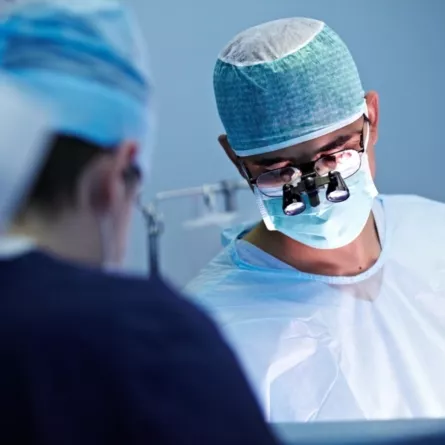
When you choose private cataract surgery with Optegra, your care is led by an experienced consultant ophthalmic surgeon who specialises in eye health and surgery.
Every Optegra consultant is NHS-trained and a Fellow of the Royal College of Ophthalmologists. Our consultants are supported by specialist ophthalmic teams and advanced diagnostic and surgical technology throughout your treatment.
Your consultant will review your eye health, talk to you about how cataracts are affecting your everyday life and explain the treatment and lens options that are suitable for you.
They’ll also make sure you understand what to expect from surgery, including the likely benefits, possible risks and your recovery afterwards.
Most importantly, there’s time to ask questions.
Cataract surgery may be routine for our specialists, but we know it isn’t routine for you. We’ll make sure you have the information and reassurance you need to make a confident, informed decision about your treatment.
Choosing where to have eye surgery is an important decision. Clinical expertise matters, but so does feeling listened to, informed and comfortable with the people looking after you.
At Optegra, we specialise exclusively in eye health.
Our private cataract patients benefit from:
Your treatment is led by experienced consultant ophthalmic surgeons, supported by specialist eye care teams.
We use detailed diagnostics and take time to understand how you use your sight before recommending a lens or treatment option.
Private cataract surgery provides access to lens technologies designed to correct astigmatism or reduce reliance on glasses where appropriate.
Your consultation, treatment and aftercare take place within dedicated eye hospitals and clinics equipped with specialist diagnostic and surgical technology.
Find your nearest Optegra hospital.
Your journey doesn’t finish when you leave the theatre. Follow-up care helps us monitor your recovery and gives you somewhere to turn if you have questions afterwards.
Feeling nervous about eye treatment is completely understandable. You’re welcome to bring a friend, family member or carer to your appointments, and our free patient chaperone service is available at every Optegra hospital.
If cataracts are starting to change the way you see the world, you don’t have to simply put up with them.
A free consultation with Optegra gives you the opportunity to understand what’s happening with your vision, explore your treatment and lens options, and ask all the questions you need to ask before making a decision.
There’s no obligation to proceed.
Or find your nearest Optegra eye hospital to explore private cataract treatment near you.
Cataract surgery is normally carried out using local anaesthetic to numb the eye. You may notice light, movement or colours during treatment, but you shouldn’t be able to see the surgery itself.
Afterwards, the eye can feel slightly gritty or uncomfortable for a short time while it heals.
At Optegra, the procedure itself typically takes around 8–20 minutes per eye.
You’ll spend longer at the hospital because time is also needed to prepare your eyes before surgery and check you afterwards.
Most private patients can have both eyes treated during the same visit.
Your consultant will assess whether same-day bilateral treatment is appropriate for you.V
Vision often begins to improve relatively quickly, although it can be blurred initially.
Your sight should continue to settle over the following days and weeks, with full recovery typically taking around four to six weeks.
That depends on the type of lens you choose and your individual eyes.
A standard monofocal lens will usually mean you still require glasses for some distances.
Enhanced and advanced lenses can reduce reliance on glasses, but no treatment can guarantee that you’ll never need glasses again.
No. The natural lens containing the cataract is removed during surgery, so that cataract cannot grow back.
Some patients develop posterior capsule opacification later, which can cause similar cloudy vision but can usually be treated with a YAG laser.
Yes, cataract surgery may still be possible if you’ve previously had laser eye surgery.
Previous laser treatment can make the measurements used to calculate your new lens more complex, so your consultant will take this into account when planning your procedure.
For suitable patients and with enhanced or advanced cataract surgery, yes.
Toric intraocular lenses can correct astigmatism at the same time as the cataract is treated.
If your cataracts aren’t significantly affecting your everyday life, you may decide to wait.
Cataracts usually progress gradually, so your optician can continue to monitor your eyesight. When your vision begins to affect your independence, work, hobbies or quality of life, you can reconsider surgery.
Yes. You’re welcome to bring a friend, family member or carer to your appointments.
Optegra also offers a free professional chaperone service at all of our hospitals if you would feel more comfortable having someone present during a consultation or examination.

Not ready for a consultation? Learn more about our range of treatments, doctors and hospitals
Information pack
Book your virtual consultation with our top rated eye hospitals
Book Now
We'll answer any questions you may have about treatment.
Private: Mon-Thu: 8am – 6pm, Fri: 8am – 5.30pm NHS: Mon-Fri: 8am – 6pm

Manage your existing bookings & payments
Patient Portal
Dr Alastair Stuart is Medical Director at Optegra, and has extensive experience in both Laser eye surgery and Cataract Surgery.
Medically Reviewed Date: 2nd September 2026